

 Posts
Posts


Pavement/Kurt Vile and the Violators
Mann Center for the Performing Arts
Philadelphia, PA
2010.09.17
"Did y'all see the Dead here? This seems like the kind of place the Dead would have played when they... when they were alive."
The cognitive dissonance may have been obvious, but it was too tempting for Stephen Malkmus not to take the bait. After all, this is their victory lap, their vindication, their chance to enjoy finally being the superstars that everyone told them they should have been throughout their career.
For this blogger, this evening was the culmination of sixteen years of waiting, anticipation, and frustration. Having been a fan of Pavement since 1994, I had faced one hurdle after another in my attempts to see the band live over the years, starting with Billy Corgan's "if they play we don't play" Lollapalooza 1994 ultimatum and culminating with an unfortunately-timed workplace injury involving a pulled neck muscle on the day of the band's final Philadelphia show on the Terror Twilight tour of 1999. Sure, in the years since I had seen Malkmus play a handful of shows with the Jicks, and those were some good shows, but the Jucks material never seemed to live up to the Pavement catalogue, which Malkmus steadfastly refused to delve into with his new band. I understand the impulse; Malkmus wanted to be seen as a currently vital artist, and not live off of his past as a nostalgia act. Perhaps part of his reasoning was also that he knew that Pavement's music was a direct result of these five individuals playing together, and that playing the songs with what would amount to a pickup band would render them defanged.
Of course, over the years I had heard stories of Pavement's legendarily sloppy, unrehearsed live shows that seemed to run the gamut from inspired but shambolic to completely disastrous, but after 16 years of waiting none of this mattered. As it happened, it was also completely irrelevant. Pavement 2010 may be the same guys, but they are nevertheless a different band than Pavement 1994.
Having never seen Pavement during its initial run, I can't comment much on specific differences between the two bands, but using old YouTube and Slow Century footage as points of comparison, I can confirm that Pavement 2010 is a much tighter, more well-oiled machine. The playing was just precise enough, while still remaining loose and spontaneous enough to not sound tired or overrehearsed. In the years since Pavement's demise, Malkmus has recast himself from sardonic slacker crown prince to a consummate professional and virtuoso, albeit one with a quick wit and cyncial sense of humor. The Malkmus fronting Pavement 2010 strikes the middle ground between these roles; he still appears all business and unsmiling onstage, but his demeanor has loosened up while playing these songs, and he injects enough ad-libs and spontaneous vocal hiccups into his delivery to betray an almost giddy sense of fun and excitement. As for the rest of the guys, they may be older, they may have lost hair in some places, grown more hair in other places, and put on some body mass in all places in general, but they were so radiant and energetic that it didn't matter. Scott "Spiral Stauirs" Kannberg may have changed so much that one would scarcely recognize him on the street, but once he started singing "Kennel District" one could not mistake him for anybody else. Mark Ibold still looks like a teenager in a pop-punk band with his hair flopping as he jumps up and down with the bass line. Bob Nastanovich is still an unpredictable madman, Pavement's secret weapon, except now he has a wireless mic and is no longer tethered to the stage area.And Steve West... well, he's still Steve West,
And the audience? The audience has perhaps changed most of all. I'm not quite sure how or why Pavement's following and legacy has changed so much in the past decade, but to a packed Mann Center (a venue that Pavement NEVER would have been able to command during its initial run), the band was received as rapturously as a religious figure might be. The band members seemed genuinely appreciative of this attention, and the energy and excitement was palpable from my vantage point in the third row. The mix of people was remarkable as well; there were veterans who had seen Pavement many times over the years and were happy to get a chance to see them off fittingly and say goodbye, there were people in my position who were old enough to have seen them the first time but missed out for one reason or another, there were even eight year-olds who knew every word to every song. This was the following that everyone told Pavement they should have had in the mid-90s, but which they could never achieve. This was their vindication. The band had a lot of fun and had an undeniable chemistry. I understand Malkmus especially not wanting to become a nostalgia act, and therefore resiting the urge to reunite for good. On the other hand, these guys have something special together and it would be a shame, and a loss for all of us as listeners, if they didn't find a way to continue working together in some capacity. Unfortunately, I do believe that the purpose of this tour is spelled out in no uncertain terms on the back cover of the tour book, which depicts a pair of puckered lips, a stack of money, and a small bird perched atop saying, "Bye-bye." Pavement broke up before being able to say goodbye the first time. They're coming back to give us a proper goodbye, but yes, they are going to take our money while doing it.
And frankly, with the quality of the show they put on (in terms of performance and setlist), I'd happily give them my money. The band opened with a sublime reading of fan favorite "Grounded," took a dig at final album Terror Twilight (and indeed, the show featured only one song from this much-maligned album), and then featured a hyperactive performance of the closest they ever had to a hit single, "Cut Your Hair," as the second song of the evening. They blasted their way through 24 more songs over the span of an hour and 45 minutes, all of them well-loved fan favorites, all of them being sung along back to the band by the entire adoring crowd. There was no "Summer Babe" and no "Carrot Rope," but given what we did get, who am I to complain?
Besides, there's always this Tuesday in New York!
Setlist:
Grounded
Cut Your Hair
Kennel District
Heckler Spray
Elevate Me Later
Frontwards
Silence Kid
Starlings of the Slipstream
Box Elder
Unfair
Fight This Generation
Shady Lane
Perfume-V
Spit on a Stranger
Stereo
Two States
In the Mouth a Desert
Conduit for Sale!
We Dance
Rattled by the Rush
Range Life
---------------------------------
Date with IKEA
Trigger Cut
Stop Breathin'
---------------------------------
(Malkmus playing "Old to Begin" during second encore break)
Gold Soundz
Here
I did record the entire set, thanks to my recording assistant Paul Mc. I had inadvertently left my external mics at home, so I had to record using the Zoom H2's onboard mics with the recorder in Paul's pocket, which is not the ideal recording setup and led to some occasional muffling and sonic anomalies, but overall it is a remarkably clean recording and sounds much better than I was expecting it to. Enjoy!
Download 2010.09.17 - Pavement as a .zip file.
Showing posts with label review. Show all posts
Showing posts with label review. Show all posts
Sunday, September 19, 2010

Thursday, April 22, 2010
I can't define it, but I know it when I see hear it.

Tonight my friend Siobhan and I attended the Philadelphia "Get Together," a listening party for the new New Pornographers album (see what I did there?), Together
 . The event was held at Kung Fu Necktie in the Fishtown section of Philadelphia, and featured free PBR (of course), PBR-branded chapstick (thankfully not PBR flavored or scented!) and all kinds of giveaways, including a pretty awesome-sounding, unlabeled spring mix compiled by Carl Newman that, 5 tracks in, seems to consist mostly of vaguely psychedelic/garage-flavored obscure rock songs.
As for the album itself, the only song that I had been exposed to before tonight was the fairly rocking "Your Hands (Together)," which Matador had already released as an mp3 download. I was aware that first official single, "Crash Years," had been released, but I had not yet heard it. The only other pieces of information that I knew about the album were that Annie Clark of St. Vincent and Will Sheff of Okkervil River both made guest appearances on the record.
The album kicks off with "Moves," an arrestingly catchy Carl-led power pop gem featuring bright, crisp production that gives the song a sheen but doesn't defang the power of the hook; it sounds arena-ready yet still raw and immediate, and frankly after two listens to the album I think it may be second only to "Mass Romantic" as the best opening song on a New Pornographers album, and in spite of the glossier production the song presents a welcome return to the general sound and feel of the New Pornographer's second album, Electric Version
 .
."Moves" proves to be only the beginning of an absolutely brilliant opening three-song salvo that continues with singles "Crash Years" and "Your Hands (Together)" - which, by the way, becomes a completely different song when blared through the PA system in a bar. I found out tonight just how much better that song becomes the louder it is played. By this point in the album, you would be forgiven for thinking that it could end up besting even Mass Romantic
 .
.The fourth track, "Silver Jenny Dollar," the first of three Dan Bejar-fronted songs, finds the Destroyer frontman in unusually poppy and accessible mode, and on first listen it seemed a bit of a let down. It's not that it was a bad song, it just didn't seem to offer a lot to hang on to. It fared better on second listen, however, perhaps because I was paying more attention to the song itself the second time through. "Silver Jenny Dollar" is followed by the Kathryn Calder-spotlighting "Sweet Talk, Sweet Talk," the song that ended up providing the biggest surprise of the album; ever since she was added to the lineup, I have found Calder to be the weak link in the New Pornographers. She just never seemed to mesh with the rest of the band, especially when attempting to sing Neko's songs during live shows. She totally makes this song work, however, and avoids making it this album's equivalent of "Failsafe." The first half of the album wraps up with an engaging ballad-ish Neko Case number called "My Shepherd."
Halfway through the album, side 1 seems to hold up as one of the most consistent album sides the Pornographers have recorded thus far. This is obviously an immediate gut reaction and not the result of extended reflection and evaluation, but right now I would rank it at least equal with the first side of Electric Version, possibly even edging that album's first half out. It is certainly a more coherent and engaging listen than the first sides of Twin Cinema
 and Challengers
 .
.The second half begins just as promisingly with the second Bejar-led song of the collection, "If You Can't See My Mirrors." As poppy as "Silver Jenny Dollar" had sounded, "Mirrors" may well be the most immediate and accessible song Bejar has written yet, and it does not suffer for it. On the contrary, it is a perfect song to kick off the second side of the platter, setting an infectiously playful tone. This gives way another Newman rocker, "Up in the Dark," that cheekily seems to crib its drumbeat from Simple Minds, coming off as a harder-edged older brother of "Don't You (Forget About Me)" - all it's missing is Carl shouting "Hey, hey, hey, HEYYYY!!!" at the beginning.
It is at this point that the album begins to lose steam and reveal its almost impossibly front-loaded nature. The well-meaning but ultimately clumsy Neko Case-sung "Valkyrie in the Roller Disco" presents the first lull in the sequencing of the album, and the remaining songs never quite recover from it. Even Bejar's remaining composition, "Daughters of Sorrow," seems somewhat lugubrious and half-hearted, as though the entire band had completely spent themselves on the first eight songs. Still, those first eight songs are almost unbelievably solid and consistent, and it is quite possible that the back third of the album will leave a better impression on me when I am listening to it in an optimal environment (i.e., not a loud bar).
My second time through I focused my attention on the instrumentation, trying to pick out the contributions of Clark and Sheff. It did not sound to me as though either one contributed vocals, although it's possible that I just didn't detect them over the din in the bar. The third Bejar song, "Daughters of Sorrow," seemed to have a distinctly Okkervil River-ish quality to the guitar tone and the interplay of the rhythm section, so I am thinking that Sheff may have at least made an appearance on that song. Throughout the album I heard several guitar lines that sounded as though they could have been the work of Ms. Clark, but I did not take not of which songs they were.
Overall, this record has immediately surpassed Twin Cinema and Challengers, and established itself as my favorite New Pornographers album in seven years. I heartily recommend it, and I look forward to being able to spend more time with it.
Also, I would be remiss if I didn't thank Siobhan for coming out, having fun, and just being awesome in general, Matador for presenting these listening parties, and Brian from Beggars for all his hard work organizing and hosting the event tonight.
Together will be released on May 4. If you pre-order the CD or LP from the Matador online store, you will receive a free three-song 7" single of non-album cover songs with your order.
Tuesday, April 20, 2010
Lifting the weight.
In which I take a step back from the controversy I have inadvertently stirred up, tackle something a lot more lighthearted, and hope that you, dear readers, will follow me down this road.
Aside from that pesky LP which will not be named, the other big release that I absolutely had to get my hands on this Record Store Day was the Life of the World to Come DVD from my favorite band, the Mountain Goats. I had already seen a screening of the film, at the New Jersey Film Festival a few weeks prior, and had intended to write a piece on it then, but circumstances forced to delay my write-up. As it is, I think a piece such as this is a necessary tension-breaker at this point, so it works out.
The film itself, directed by the talented Rian Johnson, the auteur behind Brick and the exuberantly fun The Brothers Bloom
 , is simultaneously simple and deceptively high-concept. John Darnielle returns to an auditorium in Pomona College in which he had once played a recital in his preadolescence. Accompanying Darnielle occasionally on vocals is his one-time musical companion, Rachel Ware. Darnielle and Ware perform songs from the most recent tMG album, The Life of the World to Come
 , an album of mostly reflective, ponderous (note that I intend to use this word without the negative connotation that usually accompanies it; I mean ponderous in the most objective sense possible), and low-key songs that are each titled after a Bible verse. The performance takes place on a mostly bare stage in an empty auditorium, the only audience being the film crew, the camera, and the silence.
Right from the beginning, it is clear that this is not your typical rock performance documentary film. This becomes even more obvious once it becomes clear that the entire film was actually shot on a single camera with one hour-long, unbroken shot. The camera follows Darnielle and Ware as they enter the college hall and make their way to the auditorium, the stage dressed with a piano, Darnielle's acoustic guitar, a stool, microphones, some portable lamps, and, most curiously, a circular track surrounding the performance area.
Anyone who has heard the album knows what to expect musically; these performances simply strip away the veneer of production from the album renditions, and improve most of the songs in the process. What I find most compelling about this film, however, and what I'd like to talk about, is the unique dynamic between performer and filmmaker. Ultimately, this film does not seem to be simply documenting a performance from afar, as the films of D.A. Pennebakker aim to do, nor is it using a live performance to weave an impressionistic story as the performance documentaries of Martin Scorsese and Jonathan Demme do. Rather, this film seems, more than even Demme's documentaries, to display a rare synergy and collaboration between filmmaker and musical performer.
Darnielle appears to be somewhat uncomfortable and awkward through much of the film, only losing his self-consciousness once he begins to really inhabit a song a few lines in. He speaks awkwardly to the camera as if speaking to a live audience, but seems to consciously keep his remarks less verbose and more relevant than they ordinarily would be; while this is likely due to not having the exchange of energy from the crowd, he still appears to be conscious of the banter in which he is engaging. Furthermore, the gorgeously crisp cinematography from the constantly-moving yet never restless digital camera often uncomfortably invades Darnielle's space, almost as if challenging him or goading him to retreat further into the song. Throughout the film you occasionally see crew members running across the stage to adjust something. You hear ambient sounds invading the experience as the cinematographer attaches his camera to the dolly on the track for a smooth orbit shot or as a member of the crew knocks something over. Crew members make constant adjustments to the levels on configuration of lighting. It seems as if Johnson's manipulation of the environment and willingness to invade Darnielle's space is a conscious attempt to remove Darnielle from his comfort zone, to push him and see what he will do. It is startlingly, unsettlingly intimate - as someone who has seen Darnielle perform some 35 times over the years, starting when he would play half-capacity shows at the Khyber in Philadelphia, this is by far the most intimate performance I have ever witnessed. It was simultaneously thrilling, uncomfortable, and ultimately fascinating.
The DVD also includes a lo-fi 45-minute Q&A with Johnson and Darnielle and is packaged in a gorgeous book designed by the wonderful Horse & Buggy Press and featuring song-by-song liner note commentary from Darnielle. If you can still get your hands on a copy, I highly recommend it, both for tMG fans and for fans of performance documentary or interesting cinematography.
Below, I've included a taste of the film by embedding the powerful rendition of "Ezeiel 7 and the Permanent Efficacy of Grace" from the film, as well as Johnson's first collaboration with the Mountain Goats: the mind-bendingly brilliant video for "Woke Up New" from the Mountain Goats' 2006 album, Get Lonely .
.
Aside from that pesky LP which will not be named, the other big release that I absolutely had to get my hands on this Record Store Day was the Life of the World to Come DVD from my favorite band, the Mountain Goats. I had already seen a screening of the film, at the New Jersey Film Festival a few weeks prior, and had intended to write a piece on it then, but circumstances forced to delay my write-up. As it is, I think a piece such as this is a necessary tension-breaker at this point, so it works out.
The film itself, directed by the talented Rian Johnson, the auteur behind Brick
and the exuberantly fun The Brothers Bloom, is simultaneously simple and deceptively high-concept. John Darnielle returns to an auditorium in Pomona College in which he had once played a recital in his preadolescence. Accompanying Darnielle occasionally on vocals is his one-time musical companion, Rachel Ware. Darnielle and Ware perform songs from the most recent tMG album, The Life of the World to Come, an album of mostly reflective, ponderous (note that I intend to use this word without the negative connotation that usually accompanies it; I mean ponderous in the most objective sense possible), and low-key songs that are each titled after a Bible verse. The performance takes place on a mostly bare stage in an empty auditorium, the only audience being the film crew, the camera, and the silence. Right from the beginning, it is clear that this is not your typical rock performance documentary film. This becomes even more obvious once it becomes clear that the entire film was actually shot on a single camera with one hour-long, unbroken shot. The camera follows Darnielle and Ware as they enter the college hall and make their way to the auditorium, the stage dressed with a piano, Darnielle's acoustic guitar, a stool, microphones, some portable lamps, and, most curiously, a circular track surrounding the performance area.
Anyone who has heard the album knows what to expect musically; these performances simply strip away the veneer of production from the album renditions, and improve most of the songs in the process. What I find most compelling about this film, however, and what I'd like to talk about, is the unique dynamic between performer and filmmaker. Ultimately, this film does not seem to be simply documenting a performance from afar, as the films of D.A. Pennebakker aim to do, nor is it using a live performance to weave an impressionistic story as the performance documentaries of Martin Scorsese and Jonathan Demme do. Rather, this film seems, more than even Demme's documentaries, to display a rare synergy and collaboration between filmmaker and musical performer.
Darnielle appears to be somewhat uncomfortable and awkward through much of the film, only losing his self-consciousness once he begins to really inhabit a song a few lines in. He speaks awkwardly to the camera as if speaking to a live audience, but seems to consciously keep his remarks less verbose and more relevant than they ordinarily would be; while this is likely due to not having the exchange of energy from the crowd, he still appears to be conscious of the banter in which he is engaging. Furthermore, the gorgeously crisp cinematography from the constantly-moving yet never restless digital camera often uncomfortably invades Darnielle's space, almost as if challenging him or goading him to retreat further into the song. Throughout the film you occasionally see crew members running across the stage to adjust something. You hear ambient sounds invading the experience as the cinematographer attaches his camera to the dolly on the track for a smooth orbit shot or as a member of the crew knocks something over. Crew members make constant adjustments to the levels on configuration of lighting. It seems as if Johnson's manipulation of the environment and willingness to invade Darnielle's space is a conscious attempt to remove Darnielle from his comfort zone, to push him and see what he will do. It is startlingly, unsettlingly intimate - as someone who has seen Darnielle perform some 35 times over the years, starting when he would play half-capacity shows at the Khyber in Philadelphia, this is by far the most intimate performance I have ever witnessed. It was simultaneously thrilling, uncomfortable, and ultimately fascinating.
The DVD also includes a lo-fi 45-minute Q&A with Johnson and Darnielle and is packaged in a gorgeous book designed by the wonderful Horse & Buggy Press and featuring song-by-song liner note commentary from Darnielle. If you can still get your hands on a copy, I highly recommend it, both for tMG fans and for fans of performance documentary or interesting cinematography.
Below, I've included a taste of the film by embedding the powerful rendition of "Ezeiel 7 and the Permanent Efficacy of Grace" from the film, as well as Johnson's first collaboration with the Mountain Goats: the mind-bendingly brilliant video for "Woke Up New" from the Mountain Goats' 2006 album, Get Lonely
.Thursday, March 11, 2010
You let loss be your guide: Broken Bells, 2010.03.10

Last night I had the privilege of seeing the fourth-ever show by Broken Bells, the highly-anticipated, internet-hyped collaboration between James Mercer of The Shins and production powerhouse Brian Burton, aka Danger Mouse. Only one day removed from the release of their self-titled debut album
 , the somewhat unlikely pair, who had worked together on last year's superlative Dark Night of the Soul project, played to a packed house of eager yet coolly restrained concertgoers in Brooklyn's hipster haven, Music Hall of Williamsburg.
After a brief set by Montreal-based Plants and Animals, who played a pleasant and fun if not particularly memorable set, the headlining act began to take the stage. The cure duo of stars was augmented for live performance by five sidemen, playing various combinations of lead guitar, keyboards/synths, percussion, and bass, along with backing vocals. Mercer himself stuck to guitar and lead vocals the entire evening; Burton, on the other hand, showed his versatility while jumping back and forth between live drums, guitar, and organ.
The performance from the band was almost meek, especially considering the amount of hype; the band played capably and certainly proved their chops, but displayed a lack of adventurousness by simply playing through the entire album, note-for-note, in order for the main set of the show. The band eschewed lighting effect, opting instead to play the entire show with a series of psychedelic animations projected onto them from the mixing desk, presenting a visual effect that reminded me of Andy Warhol and the Velvet Underground's Exploding Plastic Inevitable. The visuals certainly matched the music, which continues Burton's recent fascination with '60s psychedelia evident in his work on the second Gnarls Barkley album
 and his production on Beck's Modern Guilt
 . Still, though, I couldn't escape the feeling through the show that the band, and Mercer in particular, were using the projections as just a way to draw attention away from the people actually playing the music.
After the main set was finished, the lack of inspiration seemed to carry over to the audience, which applauded half-heartedly for the obligatory encore. Fortunately, having already run through their entire original repertoire, things loosened up and felt much more spontaneous and alive for the encore. First, Mercer and Burton played a short but sweet cover of Neil Young's "Don't Let It Bring You Down," then the rest of the band came out for a rocking "Crimson and Clover." The crowd ate this up, and finally seemed to believe in the band. Unfortunately, the show was over at this point. "All right, let's get a drink!" Mercer exclaimed before he exited the stage, almost as if he was aware of just how underwhelming the show had been.
Mercer has a natural ear for melody, and the embellishments by Burton do make for a nice listen on record. However, anyone who has seen the Shins live knows that Mercer seems less than comfortable in the spotlight. One would have hoped that his forming a project with one of the hottest producers of the moment, a project that was sure to generate hype and anticipation, would signal a higher degree of comfort, but sadly this does not seem to be the case. Broken Bells certainly can deliver, as long as you don't expect anything more than you already have on the record. Truly, they have nothing up their sleeves.
Setlist:
The High Road
Vaporize
Your Head Is on Fire
The Ghost Inside
Sailing to Nowhere
Trap Doors
Citizen
October
Mongrel Heart
The Mall & Misery
-------------------------
Don't Let It Bring You Down
Crimson and Clover
For a limited time, I am offering a download of my recording of the Broken Bells' set from the Music Hall of Williamsburg. Considering the album is distributed by a major label, and the band plays through the entire album, I was hesitant to do so; however, in keeping with the spirit of Danger Mouse's Grey Album and Dark Night of the Soul, I have changed my mind. I do encourage anybody who downloads and enjoys this recording to please purchase the album itself, the Amazon page for which is helpfully linked above. Files will be removed upon request. Please also note that this link will only be active for 7 days or 100 downloads, and I will not re-upload the link once it has expired. That said, enjoy!
Sunday, February 7, 2010
You've gotta look it in the eyes and say that I don't believe.
It began innocently and curiously enough last night when I read a twitter post from Sarah Lipstate, the "sound artist" behind the Noveller project (about whom I really ought to write one of these days):
 .
.
I should back up here and talk briefly about the band. At its core, Gowns was a three-piece band, a collaboration between singer/guitarist Erika Anderson (formerly of Amps for Christ), singer/programmer/viola player Ezra Buchla (formerly of west coast noise-rock institution the Mae Shi), and drummer Corey Fogel, with additional member occasionally joining for live performances. On the album, this core trio was also assisted by Carla Bozulich, formerly of the Geraldine Fibbers and currently of Evangelista. Obviously, with this pedigree and this lineup of instruments, Gowns were a special and unique creature.
Their reputation lies mostly in their prowess and ferocity as a live act, a spectacle of catharsis that was apparently difficult to match, let alone top. While I unfortunately missed out on that experience, you can hear the intensity that would lend itself to so singular a performance style. From the looks of things, it was that intensity that, unfortunately, led to their premature demise.
Musically, their debut album presents a juxtaposition of American folk music structure with dark electronic atmospherics that at times resemble some of the more experimental moments from Radiohead's Kid A/Amnesiac period, John Cale viola drones, and Xiu Xiu-esque whisper-to-a-scream vocal dynamics that leaves the listener feeling uncomfortable and even a tad voyeuristic. Admittedly, this is not feel-good music by any stretch, but there is an eerie feeling of intimacy embedded with the catharsis that, while not for everyone, is rewarding for listeners that are able to appreciate it.
According to a post on Erika's blog, as of January 3, the band were busy mixing the second album, a time-consuming, work-intensive, tedious, and exacting process that the band went through collectively, without outsourcing:
Within 4 weeks, apparently, Gowns were an entity that existed firmly in the past. In its wake, the band left one last missive, a 17-minute behemoth of a track called "Stand and Encounter" that dials down the folk and dials up the post-rock, sounding at times like Mogwai, Sonic Youth, and the Velvet Underground jamming with the Swans. Again, it's not for everyone, but it's free to try, both in a streaming clip and as a free download of its full 17-minute glory. It now stands as the only artifact of a sophomore album what will presumably never be realized, and the finality of Erika's words on the matter are both gratifying and heartbreaking:
and this final track, Gowns leaves behind a self-distributed EP, recently reissued on vinyl, and a limited edition live session on LP called Broken Bones. Both are available in limited quantities directly from Erika, and Red State can be purchased in CD or MP3 format from Amazon.com. Erika also has a new, more traditionally folk-inflected project, Some Dark Holler, in the works. You can listen to two songs from the project at her website.
MP3: Gowns - "Stand and Encounter"
Erika Anderson/Gowns website

RIP Gowns. Listening to their final track release: http://somedarkholler.files.wordpress.com/2010/02/gowns_stand.mp3I had heard of Gowns in passing before, but had never explored their music. Curiosity piqued, I clicked through and listened. What happened next is perhaps somewhat predictable. Within the hour, I had a digital copy of their debut (and apparently only) album, Red State
.I should back up here and talk briefly about the band. At its core, Gowns was a three-piece band, a collaboration between singer/guitarist Erika Anderson (formerly of Amps for Christ), singer/programmer/viola player Ezra Buchla (formerly of west coast noise-rock institution the Mae Shi), and drummer Corey Fogel, with additional member occasionally joining for live performances. On the album, this core trio was also assisted by Carla Bozulich, formerly of the Geraldine Fibbers and currently of Evangelista. Obviously, with this pedigree and this lineup of instruments, Gowns were a special and unique creature.
Their reputation lies mostly in their prowess and ferocity as a live act, a spectacle of catharsis that was apparently difficult to match, let alone top. While I unfortunately missed out on that experience, you can hear the intensity that would lend itself to so singular a performance style. From the looks of things, it was that intensity that, unfortunately, led to their premature demise.
Musically, their debut album presents a juxtaposition of American folk music structure with dark electronic atmospherics that at times resemble some of the more experimental moments from Radiohead's Kid A/Amnesiac period, John Cale viola drones, and Xiu Xiu-esque whisper-to-a-scream vocal dynamics that leaves the listener feeling uncomfortable and even a tad voyeuristic. Admittedly, this is not feel-good music by any stretch, but there is an eerie feeling of intimacy embedded with the catharsis that, while not for everyone, is rewarding for listeners that are able to appreciate it.
According to a post on Erika's blog, as of January 3, the band were busy mixing the second album, a time-consuming, work-intensive, tedious, and exacting process that the band went through collectively, without outsourcing:
We typically mix everything ourselves, and that’s like hand stitching. You know how you can listen to Red State over and over again? That took a long time. I want to make things that wear well, and a lot of that is really obsessive, tasteful mixing…
Within 4 weeks, apparently, Gowns were an entity that existed firmly in the past. In its wake, the band left one last missive, a 17-minute behemoth of a track called "Stand and Encounter" that dials down the folk and dials up the post-rock, sounding at times like Mogwai, Sonic Youth, and the Velvet Underground jamming with the Swans. Again, it's not for everyone, but it's free to try, both in a streaming clip and as a free download of its full 17-minute glory. It now stands as the only artifact of a sophomore album what will presumably never be realized, and the finality of Erika's words on the matter are both gratifying and heartbreaking:
Although it is sad that the band burnt out so quickly, the cliché is true: they also burned brightly. This is intensely moving music for those that can appreciate it, and ultimately if they had not been the kind of band to burn itself out so quickly, the recorded legacy they left behind would not be as special as it is. I feel lucky to have found out about them, however late, and I hope you check them out to. In addition to Red StateWe were tapping into some very raw emotions, and I’m ultimately proud of the risks we took. In spite of anything else, I feel like we were honest, and I feel like we were brave.
I’m also proud of the sounds we created, as though the combination of our talents created something that was rare and unique.
-Before this we were just finishing work on a piece for our next record, and I think in many ways it’s one of the best things we’ve done. At 17 minutes long, it’s a good representation of everyone doing the best of what they do best: it’s got Corey’s frenetic yet graceful drum patterns, Ezra’s swelling viola drones, a rhythmic and powerful guitar line, and a vocal and lyrical style that is at once direct and oblique.
-I’m posting it here as a free download, because I know people were anxious to hear something new from us, and I know we had kept them waiting far too long. I’d like to think of this as our final release.
I’m sorry we couldn’t keep it together.
and this final track, Gowns leaves behind a self-distributed EP, recently reissued on vinyl, and a limited edition live session on LP called Broken Bones. Both are available in limited quantities directly from Erika, and Red State can be purchased in CD or MP3 format from Amazon.com. Erika also has a new, more traditionally folk-inflected project, Some Dark Holler, in the works. You can listen to two songs from the project at her website.MP3: Gowns - "Stand and Encounter"
Erika Anderson/Gowns website
Tuesday, June 9, 2009
This is how I am repaid: The Decemberists/Robyn Hitchcock & The Venus 3, 2009.06.06
The Decemberists/Robyn Hitchcock & The Venus 3
Tower Theater
Philadelphia, PA
2009.06.06
Tower Theater
Philadelphia, PA
2009.06.06

I never wrote about it on this site (mostly because, let’s face it, I was pretty much ignoring this site until just a couple of weeks ago), but the new album from the Decemberists, The Hazards of Love, has ranked highly on my list of the biggest musical disappointments of the year. I was excited for the album, and was prepared to fall head-over-heels in love with it; really, I was. I wanted to memorize every word and to dutifully listen to the entire saga at least once a week. I wanted this to be the album that fulfilled the widescreen ambition of “The Tain.” Instead, I found the album to be tedious, dull, confusing, unmemorable, and, ultimately, underwhelming in spite of its by-design overwhelmingness. Of course, by the time the album came out and I had gotten the chance to bask in its apparent mediocrity, I had already had the tickets for this show for a month. Although I was at first excited at the prospect of seeing the band perform what should have been its magnum opus in its entirety, I swiftly began to regret purchasing tickets for the show, especially as both Art Brut and the Roots Picnic were announced for the same date.
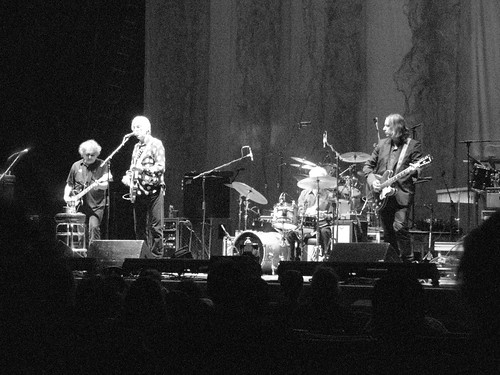
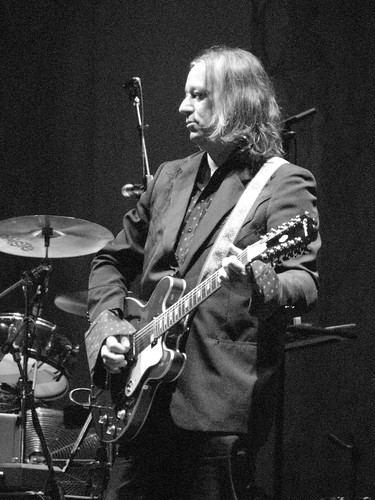
Flash forward to this past Saturday. After a quick dinner at Pico de Gallo and a madcap, Paperboy-inspired rush through the city, Jenn and I entered the Tower Theater and found our seats. I was excited that Robyn Hitchcock was opening the show; in fact, I was perhaps more excited to see Hitchcock than I was for the main act at this point. It must be said that I have not purchased a Robyn Hitchcock album since 1999’s Jewels for Sophia, so going into this show I assumed I would be unfamiliar with most of the material. I also was unfamiliar with the makeup of his backing band, the Venus 3. I had been aware that he had been doing some work lately with R.E.M. guitarist Peter Buck, as well as Young Fresh Fellows/the Minus 5 main man and touring R.E.M. member Scott McCaughey. What I was not aware of was that the Venus 3 was basically a stripped-down version of R.E.M. – I was shocked to see Peter Buck stroll out onto a smaller stage than I could ever reasonably hope to see R.E.M. play, along with Scott McCaughey and touring R.E.M. drummer Bill Rieflin.
The entire band was in fantastic form, and I had forgotten in the nine years since I had last seen him live just how devastatingly funny Hitchcock was in concert – the absurdity of his ramblings left one simultaneously rolling with laughter and scratching one’s head looking for comprehension. (“Well, it is June, which means that Halloween is in October this year, and this is a wonderful time to be in Philadelphia, because Halloween is coming up soon. Get ready to carve your pumpkins!”) A series of increasingly tiny tour companions/mascots being introduced (a penguin, an alligator, and a cone) presented other moments of surreal, absurd humor that seemed to confuse just as many people as they tickled.
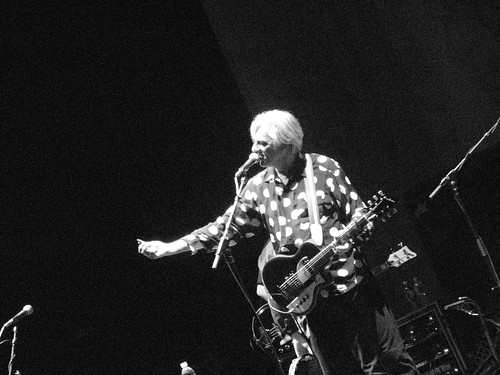
I do not mean, however, to imply that the banter stole the show from the music. Far from it – Hitchock’s music came off as vital and energetic. Opener “I Often Dream of Trains” pleased the fair number of already-familiar fans in the audience before Hitchcock and company veered into a set comprised mostly of ear-pleasing recent material. The Byrdsian jangle of “I’m Falling” was a particular highlight to me, as well as the obvious-but-still-funny ode to media anaesthetization “Television,” Rachel Getting Married centerpiece song “Up to our Nex,” and the twenty-year-old “Queen of Wasps,” which was the only other older song played by the band. Buck’s jangly guitar style was a perfect match for Hitchcock’s whimsical songwriting style, and the newer songs played were good enough that I felt not a twinge of hesitation as I purchased a copy of the most recent album, Goodnight Oslo, and had it signed by both Hitchcock and Buck.

There is no way to build up to this effectively, so let me just cut to the chase and spoil it for you now: the Decemberists rocked it, and they managed to acquit themselves admirably and prove me wrong about The Hazards of Love. Perhaps it was the added effect of seeing the band make the transition from song to song expertly and professionally, perhaps it was the stage presence of Colin Meloy and Shara Worden, perhaps it was the chemistry that I must stubbornly admit that Mr. Meloy and Becky Stark had, or perhaps it was the fact that, as a captive audience being presented with the material at loud volume, I actually listened fully for the first time. Whatever the reason was, the fact is that the album clicked for me for the first time. Where its 60 minutes had previously seemed to drag on for multiple hours, here it flew by and left me wanting more. Where the whole piece had seemed to blend into some bloated, ultimately insignificant blur of disconnected sounds with no real songs distinguishable from the whole apart from obvious single “The Rake’s Song,” here the individual songs took shape and individual identities.
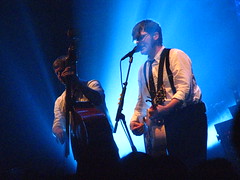
The puzzling thing about this is the fact that there was, to my ears, no difference between the studio version of the album and the live version. The Decemberists at this point are an accomplished and professional enough band to pull off a suite such as this and play it exactly as it is on record – I caught no mistakes, no timing changes, no flubbed lines or bum notes or missed drum beats. It was all perfect. Added to that is the pristine sound of the Tower – even from practically the extreme right wall of the room, there was no echo. The live mix perfectly balanced all the elements, so nobody overpowered and nobody got drowned out. The band took the stage without addressing the audience at all, and did not stop playing, speak to the crowd, or in any other way break character throughout the first set. It was a performance in the truest sense of the word.
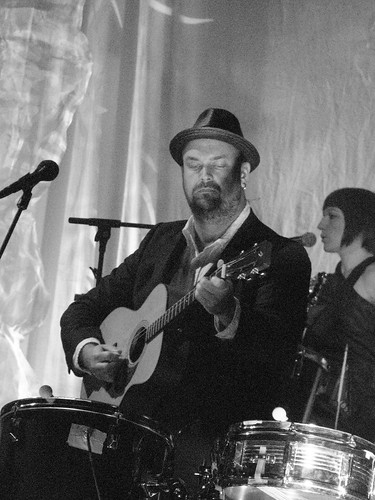
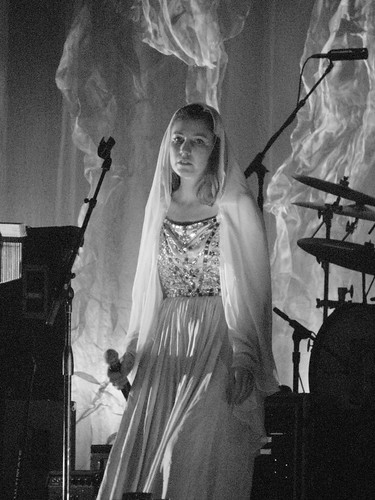
And what a performance it was! Mr. Meloy rocked out at several times, taking obvious delight in some of the unexpectedly sludgy riffs that pepper the suite. Ms. Stark, playing the role of Margaret, had the biggest hurdle to clear; I had seen her band, Lavender Diamond, open for the Decemberists a couple of years ago, and I was none too impressed by the band and was particularly not a fan of Ms. Stark. At that show, she seemed to be conveying an image of purity, innocence, and a vaguely hippie-ish sense of idealism that felt disingenuous. Even worse, her singing voice seemed blandly unimpressive and she had no physical stage presence. I was disappointed when I had learned she would be playing a prominent role on this album. Live, however, she displayed at least an improvement in her stage presence; her first entrance as Margaret, dressed in a white bridal gown, saw her executing a provocatively sensual, undulating shimmy up to the mic, swaying in time to the rhythm established by the band, injecting a brazen and unexpected sense of sexuality into the character and the scene. While her voice still left much to be desired, it was obvious that her touring with Lavender Diamond had allowed her to grow as a vocalist.
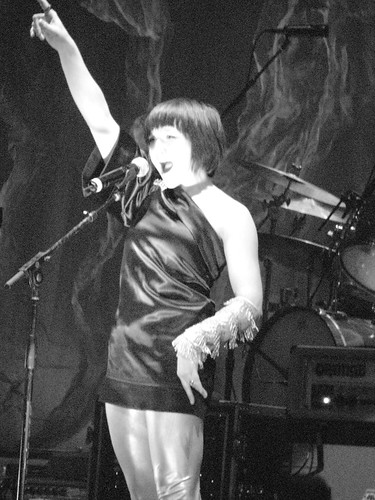
She was completely out-awesomed on every level, however, by Ms. Shara Worden, playing the queen. In her little black dress, Ms. Worden vamped, stomped, and generally took control of the stage during her too-few appearances in the storyline. While Jenn seemed to think that Ms. Worden’s overacting was unnecessary, I respectfully disagree; to me, the queen is the kind of character that was written to be a scene- and show-stealer, and the only way to effectively play such a character is to camp it up. And camp it up she did – Worden’s larger-than-life performance on “The Wanting Comes in Waves/Repaid” definitely stole the show away from Meloy and elicited what sounded to me like the largest applause of any moment during the Hazards set, besides perhaps “The Rake’s Song,” which was performed by Mr. Meloy on acoustic guitar and vocals, Nate Query on electric bass, and the other five on-stage members all (!) playing drums in unison.
Of course, after playing Hazards and taking a well-deserved 15-minute break, the band were back, sans costumes, to play an abbreviated set of shorter, more self-contained, and less thematically and narratively-loaded songs. After all the restraint he displayed during the main set, Mr. Meloy here perhaps went overboard on the banter, proclaiming himself a charter member of MACOF (Musicians Against the Calling Out of Freebird) and, in one head-scratching moment, declared that the chord change in “Dracula’s Daughter” is “douchey.” (Really, Colin? With the vocabulary you display in your songs, you choose to go there?) The music, however, was top notch, and was a great plate-cleanser after the intensity of the live Hazards experience.

The highlights here undoubtedly were saved for the climactic final two songs of the set – “The Chimbley Sweep,” which saw Mr. Meloy and Chris Funk hand off their guitars to audience members and run into the audience, shaking hands and high-fiving; and a ripping, energetic cover of Heart’s “Crazy on You,” with Ms. Worden and Ms. Stark trading off lines and verses, and Ms. Stark once again coming out of the deal overshadowed. It was an epically huge performance and was executed – imagine this – without an ounce of irony detectable. The encore stated off slowly with a performance of the rather meh Picaresque outtake “The Bandit Queen,” but improved exponentially with a singalong performance of “Sons & Daughters.”

Although I walked in to the theater convinced I was going to have a terrible time at this show, the Decemberists managed to prove me wrong, and I was humbled by the technical precision of their show, as well as by the care that went in to the visual presentation of the concert (the backdrop may have looked like nothing at first, but it really became quite a striking element of the performance). While I had started to doubt the greatness of the band, I am impressed that they managed to follow up a record that got my vote for biggest disappointment of the year with the most unexpected success of the year.
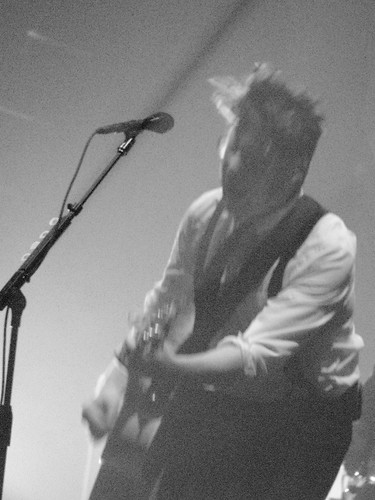
Robyn Hitchcock & The Venus 3 setlist:
I Often Dream of Trains
What You Is
Saturday Groovers
Madonna of the Wasps
I'm Falling
Television
Up to Our Nex
Creeped Out
The Authority Box
Goodnight Oslo
The Decemberists setlist:
Prelude
The Hazards of Love (The Prettiest Whistles Won't Wrestle the Thistles Undone)
A Bower Scene
Won't Want for Love (Margaret in the Taiga)
The Hazards of Love 2 (Wager All)
The Queen's Approach
Isn't It a Lovely Night?
The Wanting Comes in Waves/Repaid
An Interlude
The Rake's Song
The Abduction of Margaret
The Queen's Rebuke/The Crossing
Annan Water
Margaret in Captivity
The Hazards of Love 3 (Revenge!)
The Wanting Comes in Waves (reprise)
The Hazards of Love 4 (The Drowned)
----------------------------------------------
The Crane Wife 3
Shiny
Sleepless
July, July!
Summersong
Dracula's Daughter
O Valencia!
The Chimbley Sweep
Crazy on You
-----------------------------------------------
The Bandit Queen
Sons & Daughters
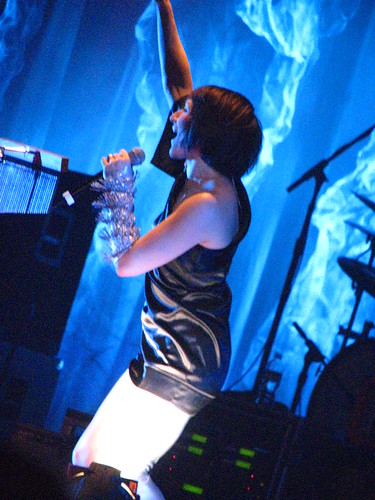
Complete set of photos from the show, as usual, can be viewed at Flickr.
Monday, June 8, 2009
Like a god, or a good luck charm, or a vice: PJ Harvey & John Parish, 2009.06.07
PJ Harvey & John Parish/Pop Parker
The Trocadero
Philadelphia, PA
2009.06.07
It is almost 1:00 AM and I am tired, but I feel like I just need to churn this one out right now. I just got back from seeing PJ Harvey and John Parish play the Philadelphia stop on their first joint US tour (possibly their first joint tour ever? Can anybody confirm this?). Harvey and Parish put out a collaborative album back in 1996 called Dance Hall at Louse Point, a collection which often fell squarely within the experimental side of the songwriting spectrum. Although it had its share of good tunes, the album as a whole never felt entirely cohesive to me and just never fully clicked with me. Still, as a PJ Harvey devotee, I have held onto the album all these years and every now and then pull it out and give it a listen.
The Trocadero
Philadelphia, PA
2009.06.07
It is almost 1:00 AM and I am tired, but I feel like I just need to churn this one out right now. I just got back from seeing PJ Harvey and John Parish play the Philadelphia stop on their first joint US tour (possibly their first joint tour ever? Can anybody confirm this?). Harvey and Parish put out a collaborative album back in 1996 called Dance Hall at Louse Point, a collection which often fell squarely within the experimental side of the songwriting spectrum. Although it had its share of good tunes, the album as a whole never felt entirely cohesive to me and just never fully clicked with me. Still, as a PJ Harvey devotee, I have held onto the album all these years and every now and then pull it out and give it a listen.
Its experimental nature, lack of promotion or live acknowledgment of its songs, and relative forgotten status among the record-buying public made it one of the candidates for the least likely side project to spawn a follow-up album. So imagine my surprise when, earlier this year, it was announced that PJ Harvey and John Parish would release their second collaboration, A Woman a Man Walked By. I dutifully picked up the album on release day to find it a curious listen of which I could not quite make heads or tails - it was filled with moments of pure pop songwriting the likes of which were not hinted at on Dance Hall (see "Black Hearted Love" and "Passionless, Pointless"), but its more abrasive or experimental moments were utterly uncompromising, making similar gestures on Dance Hall seem like training drills. The album came out of nowhere with little advance notice, and demanded that you accept it on its own terms or leave it be.
The show last night was opened by UK singer/songwriter Pop Parker, who took the stage with his acoustic guitar and strummed some pretty chords while gently crooning, "Mother, mother, mother, mother..." Just when you thought he was about to sing an utterly unironic, tender ode, he continues, "mother, mother, FUCK!" with a muted pound on the strings. This short, nonsensical song set up the duality present in most of the songs he played during his half-hour set: they tended to comprise chord progressions and melodies that were superficially pretty and pleasing to the ear, but the lyrics, which initially hint toward tenderness and sincerity, show a preference for reversal either into the vulgar or into anxiety and hopelessness. Unfortunately, though I found myself chuckling at the cleverness of many of Mr. Parker's lines, I have found that the songs are not as memorable as they first seemed to be. (Of course, that could just be the mind-erasing effect of seeing PJ Harvey perform directly afterwards.)
Harvey and Parish's set - where to begin? First of all, it needs to be said that PJ Harvey doesn't just perform, she commands the stage. While she may not fall into the conventionally attractive category, I personally have always found her beautiful, with a sense of confidence, self-assuredness, and power that only adds to her air of mystery and makes her more attractive. She took the stage last night barefoot in a simple black dress, fingernails painted black. Lest it sound like PJ Harvey: In a Goth Mood, though, I should add that she was all smiles through the night - there were several moments, in fact, between songs where she and Mr. Parish simply stood there, beaming at each other, basking in the zealous applause of the crowd of die-hard fans.
These are the fans, after all, who knew all the songs by heart - the forgotten side project from thirteen years ago. And although I didn't think I had listened to Dance Hall all that much, I was surprised at how much I knew of the songs - the words came right back to me. The stage and the lighting were both as unadorned as Ms. Harvey's stage costume. Under the stark conditions, the sometimes skeletal songs were even more striking. A particular standout for me was "Taut," always a favorite of mine. While the studio version features Ms. Harvey whispering the vocals in a frightened tone that gave the song a terrifying edge, here she sang the song in a more self-aware tone that suggested the narrator of the song was not so helpless as she had previously seemed, adding an additional layer of melancholy and pity to the story.
Harvey and Parish, with a three piece band, including legendary keyboardist and bassist Eric Drew Feldman, ended up playing for nearly 90 minutes, including a lengthy encore break during which they really made the crowd work for it; I had begun to think that perhaps they really weren't coming back out. In typical uncompromising fashion, the encore was somewhat anticlimactic - the band played a John Parish solo song called "False Fire," and ended the evening with the slow, melancholy, and eerie song "April" from A Woman a Man Walked By. Ending the show on such a note left this reviewer with a somewhat uneasy feeling - though they could have gone the easy route and sated the crowd with a reading of "Is That All There Is?", "City of No Sun," or any song from PJ Harvey's back catalog, they chose to end with possibly the least likely song from either of their two albums and leave the adoring crowd wanting more. Judging from the rapturous applause, in which the pair basked for a moment before filing off stage, the crowd did want more - but they were appreciative just to have gotten anything at all from this reclusive pair of talents.
Setlist:
Black Hearted Love
Sixteen, Fifteen, Fourteen
Rope Bridge Crossing
Urn with Dead Flowers in a Drained Pool
Civil War Correspondent
The Soldier
Taut
Un cercle autour du soleil
The Chair
Leaving California
A Woman a Man Walked By
Passionless, Pointless
Cracks in the Canvas
Pig Will Not
------------------------------------------
False Fire
April
I had to check my camera, but I did take a few crappy iPhone photos. Vanity forbids me from using them, since my standards are higher, but since I like including photographs with my reviews, I will likely relent. Not tonight, though.
Sunday, June 7, 2009
Keeping up with the motions: Grizzly Bear, 2009.06.02.
Grizzly Bear/Here We Go Magic
The Trocadero
Philadelphia, PA
2009.06.02

When I met Ed Droste from Grizzly Bear last year before Radiohead’s Camden show, I made him wince with just a few simple words: “The first time I saw you guys was at the Knitting Factory in 2005.” With a grimace, Mr. Droste replied, “God, we were rough back then.” While I would not agree with Mr. Droste’s self-deprecating and dismissive assessment of the band’s early live performances, during which they were still trying to find their collective voice, I bring it up because I think it speaks volumes about Grizzly Bear’s evident and rapid reinventon, refinement, and remodeling of its own image. In short, although the lineup is the same, the band that I saw at the Trocadero on Tuesday evening is not the same band that took the stage to open for the Mountain Goats on Halloween of 2005. (It would be unfair to compare the records, since Horn of Plenty is essentially a solo bedroom project from Droste.)
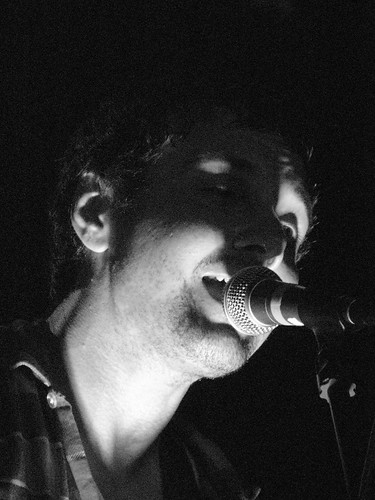
The show, which was my fifth Grizzly Bear show, although it was my first time seeing them in a headlining capacity, featured Here We Go Magic as the opening act, a band that I had heard of (most likely due to their support act slot for Grizzly Bear member Daniel Rossen’s other songwriting vehicle, Department of Eagles) but never actually heard. A quick listen to a YouTube video posted on their website told me that they basically sounded like a less trippy, more whimsical Animal Collective clone. Fortunately, their live show disproved this quick and possibly lazy assessment. The five-piece band did display myriad easily-recognizable influences – among them Animal Collective (the drummer frequently fell into a primal, insistent tom beat that only needed some delay in order to sound like an imitation of Panda Bear’s style) and Radiohead (one of the songs midway through the set featured guitar interplay eerily similar to “Arpeggi” – yet it has proven impossible for me to definitively peg down their sound or to compare them to any particular band. Which is not to say that they were shrouded in mystery; I did not find them nearly that intriguing. In fact, I was not particularly impressed until the band seemed to hit its stride during the last three songs or so of the set. The next-to-last song in particular – the one during which the singer took to the keyboards (sorry, I don’t know band member names or song titles) – was an interesting and compelling song that left me wanting more. For the most part, however, four days after seeing them play I find much of their set forgettable.
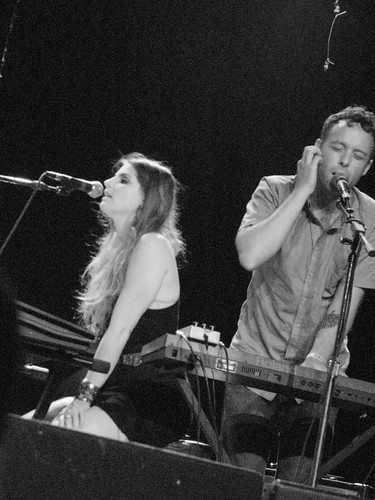
As the stage was being set for Grizzly Bear, the excitement and anticipation in the sold-out room was palpable. This is one thing that has puzzled me; while I am obviously a fan of Grizzly Bear and obviously I am happy for them and do not in any way begrudge their seemingly sudden success (yay alliteration!) and ascension into current indie rock royalty, I am not exactly sure of HOW this happened. How did such a reserved, nuanced, subtle band suddenly become one of the it-bands of the year? Surely the support slot for Radiohead last year and the media boost from Jonny Greenwood must have helped, but I am amazed by just how big they seem to have gotten nearly overnight. And my Flickr and blog support this; within 24 hours of my initial posting of the setlist on this blog and the photographs of the show on my Flickr page, both pages registered record-high numbers of hits.
However, this is a review of the show and not of the phenomenon. The setlist yielded few surprises: Very little from Horn of Plenty, a choice handful from Yellow House, and seven songs from this year’s mighty (and mighty pretty) Veckatimest. Having already seen them four times, I knew what to expect: the band sets up with all four members sharing the front of the stage; the harmonies are just as achingly beautiful live as they are on record; Chris Taylor makes lots of endearingly silly faces while singing the high vocals on “Knife” and pulls out his clarinet for some bass tones, always one of the sonic highlights of a Grizzly Bear show.
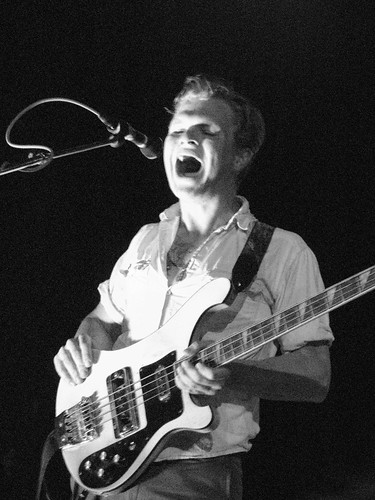
There is something about Grizzly Bear’s stage presence which I am not sure I can articulate that makes them extremely compelling and exciting to see. They are not a particularly visceral band – even during their rock-out moments, do not expect to see any of the band members jumping or thrashing about. Everything about Grizzly Bear seems to be about control and restraint. As such, apart from Mr. Droste’s slight dance moves during “Cheerleader,” there is not much movement. Every sound seems carefully considered, as if one wrong thread will ruin the overall effect of the tapestry. Yet, as careful and considered and fragile as the music seems, there is still a physicality to the music that lends the performance a weight not present in the records, no matter how close to perfect they may be.
The highlight of this show, besides the absolute gorgeousness that is “While You Wait for the Others” and the magical, rolling melody that makes “Ready, Able” such an irresistible tune was the completely unexpected introduction of special guest Victori Legrand from the band Beach House to song along with the boys on current single “Two Weeks.” Although it seemed to my ears like her microphone was a little low and her presence ultimately didn’t add terribly much to the sonic palette, the response from the audience made this feel like a capital-E Event, and immediately upped the ante for the song. Additionally, the sublime performance of “Fix It” was a personal highlight for me; although I have heard this performed several times before, it has never sounded quite so nuanced and psychedelic as it did Tuesday night. The hushed performance of “Shift” was also very pleasant, and I was happy that Grizzly Bear performed two of my favorites from the first album – unlike other bands who pretend that their back catalogs have ceased to exist (I’m looking at you, the National).
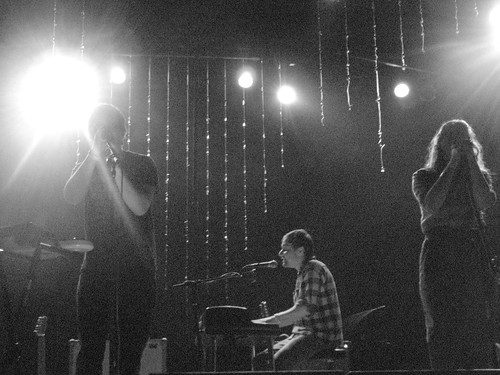
Any gripes or criticisms of the show are minor: it would have been nice to maybe hear some more full-band arrangements or re-arrangements of Horn of Plenty songs; although seven songs from Veckatimest were played, I had already heard four of these (“Cheerleader,” “Fine for Now,” “Two Weeks,” “While You Wait for the Others”) performed last summer, and so it would have been nice to have had more variety in the new selections; and while it felt great to get out of a show before 11:00pm, the set seemed just a tad short. But, as I said, these are minor criticisms thrown in so that the review doesn’t seem completely fawning. These guys grow as performers every time I see them, and they also grow as songwriters and sonic sculptors with every album. On Veckatimest, they seem to have fulfilled the promise of Yellow House and taken that sound to its logical conclusion. I am not sure where they are going next, but I will be happy to follow them.
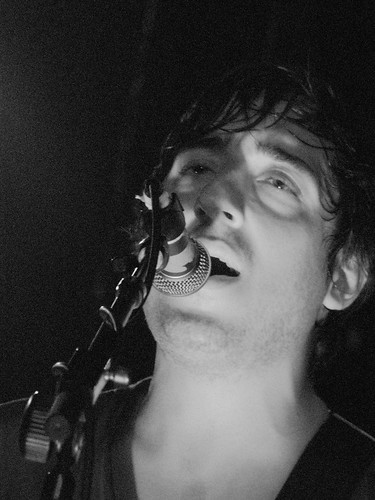
Grizzly Bear setlist:
Southern Point
Cheerleader
Little Brother
Knife
Fine For Now
Two Weeks (w/ Victoria Legrand)
Ready, Able
Shift
I Live With You
Fix It
While You Wait for the Others
On a Neck, On a Spit
---------------------------------------
Colorado
For another perspective on the show, I encourage you to visit AK’s review on her blog.
To see all of my photos from the show, please visit my Flickr page.

Thursday, June 4, 2009
What Makes You Think I'm Enjoying Being Led to the Flood?: The National, 2009.05.29
The National/Colin Stetson
The Electric Factory
Philadelphia, PA
2009.05.29
IV. Flirting with Disaster
As you will recall from last time, dear readers*, Anthony, Bill and I (and Bill’s girlfriend, Jess) had decided to fly in the face of disaster and thumb our noses at the National Curse, purchasing four tickets to the May 29 show at the Electric Factory. And predictably… nothing happened. There was no grand disaster. Hell, security didn’t even try to stop me and tell me that my camera wasn’t allowed. It all went so very, very smoothly. Perhaps the third time is a charm? (I decided to forgo the full description of the events leading up to the show itself, mostly because Bill has already posted a thoroughly entertaining, complete, and accurate account on his blog. He did mercifully leave out the part where I made an ass of myself and cracked the windshield of my car, but I just negated that act of kindness in spectacular style. Also, in case anyone is curious as to what my aka acquisitions were: The Thermals – Now We Can See LP; John Phillips – John, The Wolfking of L.A. LP; Red Hot + Bothered 10” compilation. Record stores are awesome.)
All that was left to do now was wait.
V. The Trick Is to Keep Breathing
Colin Stetson was the opening act. I did not know what to expect, having never heard of him before, but I was surprised to see the stage set up with a lone microphone, a baritone sax and what appeared to be an alto sax. When he came out and began playing unaccompanied, I began to wonder how an act such as he had been chosen to open for a rock band. This is not to say that he was bad – quite the opposite, in fact. He was wonderful. Unfortunately, I don’t really know how to explain his style. Bill described it as “techno played on a saxophone,” but I don’t really agree with that assessment (with all due respect, Bill). If anything, and I know that saying this makes me sound like a pretentious, over-intellectual douche, but his composition and even his playing style reminds me of the work of Erik Friedlander. The compositions, which I am assuming were originals, were marked with a good deal of unorthodox technique; techniques that I don’t know the names for, because I know almost zilch about saxophones and therefore cannot speak about his set with even a pretense of intelligence or knowledge. So I will stick to what I know: the music rocked without being rock music; his combination of sustained mournful tones through circular breathing with the groove of low pedal tones and an almost beatbox-like effect that he employed when playing the baritone created an effect that I had never heard from a sax player. I was kind of almost dancing, even, and everyone knows that the almost never happens. Mr. Stetson only played a four- or five-piece set, and seeing the amount of effort he put into playing the compositions, particularly those for the baritone, I was kind of surprised he played for that long; they obviously required a degree of physical stamina and discipline to which I simply could not relate. Looking around, I was surprised to see how many other people seemed to be enjoying his set. I had expected people to either be indifferently bored or to actively dislike it. Once again, my misanthropy and faux-elitism let me down.

VI. Go Ahead, Go Ahead, Throw Your Arms In the Air Tonight
The National were nothing short of powerful, captivating, and spellbinding from the start. Opening the set with a new song of quiet, controlled intensity, “The Runaway,” was a remarkably audacious move – not only did the band risk alienating fans by not drawing them in with an instantly recognizable song, but they also dared to set the bar almost impossibly high by kicking things off with what they must know is possibly one of their most endearingly majestic and hypnotic songs yet. Indeed, the song was one of the absolute high water marks of the show for me, and is quickly making me very excited for the next album.
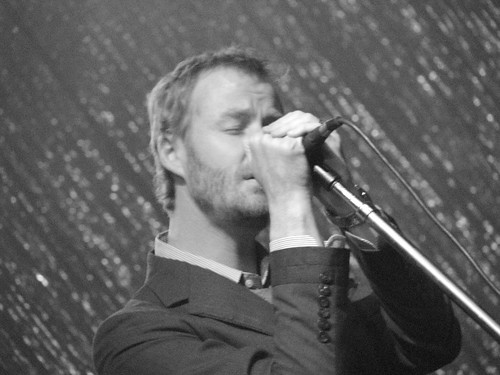
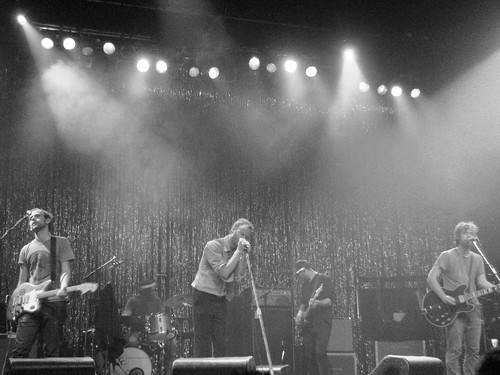
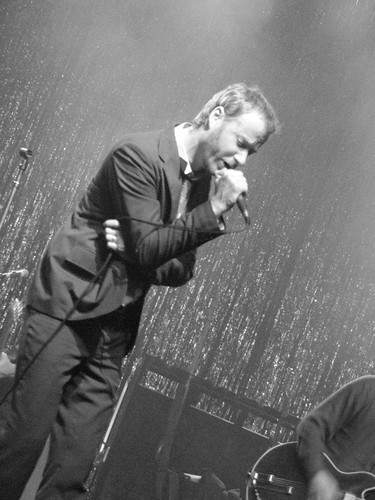
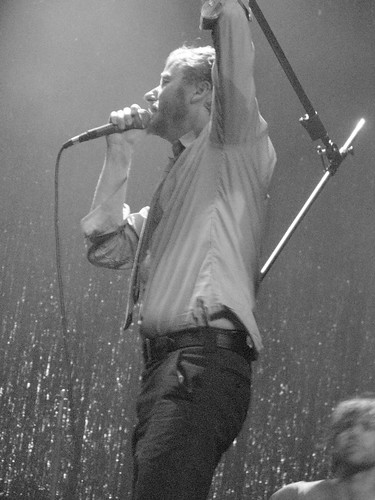
The National live are all about presence. Looking at my photos, you will note that Matt Berninger has approximately two “poses” while singing; in essence, if you’ve seen one photo of Matt performing you’ve seen them all. Photographically, this would suggest a certain stasis, a stiffness, a detachment from the performance. In truth, however, none of this is true. While Mr. Berninger may look boring/ed in the photographs, witnessing him perform live, the closest analogy I can think of is a preacher; there is such an intensity to his stage presence, and when he grips the microphone just so and half-hugs himself, it is with CONVICTION. And his eyes, when he opens them, have that slightly wild, distant look that is often associated with the true fanatic. When he’s not at the microphone, Mr. Berninger stalks around the stage like a feline, pacing back and forth, eyeing the crowd, seeming to focus in on the energy of the room and feed off of it. Unfortunately, anybody who has not seen the National live probably cannot recognize any of this in the photos. Those of us who have shared this experience, know, though. The National, in spite of the brooding, is an affirmation of life, a controlled explosion of energy and emotion.

The band, augmented by three horn players (including Colin Stetson) and keyboardist Doveman, was flawless, in spite of the absence of violinist Padma Newsome. I don’t want this review to turn into a groveling praise fest, but the band were really just that good. I really only have two criticisms to offer. The first is the setlist: it would really be nice for the band to acknowledge that they released records before Alligator. Seriously, “Fashion Coat,” “Murder Me Rachael,” “Wasp Nest”… I would have loved to hear almost any of the songs from Cherry Tree or Sad Songs for Dirty Lovers. Or even rearrangements of songs from the first album. And what about a stripped-down reading of “So Far Around the Bend”? As much as I love both Alligator and Boxer, I think some representation of their pre-fame albums wouldn’t hurt. As it is, their current live set makes it seem as if these two albums are the length and breadth of their career. I just think that sticking almost exclusively to this material represents a missed opportunity and almost implies that the earlier work is inferior or unworthy, which is absolutely untrue.
My second complaint: the horn section absolutely ruined “Slow Show,” which is possibly my favorite song from Boxer. It’s a shame. That song needs to be more stripped down.

Still, though, when all is said and done these complaints/criticisms don’t amount to much. The boys put on a memorably spellbinding show, played their asses off, and debuted three songs that, if they are representative, indicate that album #5 could conceivably be their best yet. If that’s the trade-off, then sure, I’ll endure a curse.
Setlist:
The Runaway (new song)Start a WarMistaken for StrangersBrainySecret MeetingBaby, We'll Be FineSlow ShowVanderlylle Crybaby (new song)Squalor VictoriaAll the WineAbelAdaApartment StoryGreen GlovesFake Empire-------------------Blood Buzz Ohio (new song)Mr. NovemberAbout Today

For other perspectives on the show, I strongly urge you to check out Jess’s review over at Crawdaddy or A.D.’s review at Music Maven. Both are very well-written reviews by awesome people whose blogs you should be reading on a daily basis anyway.
My entire set of photos from this show can be viewed at Flickr.
Also, after all my praise of "The Runaway," why don't you check out this awesome, high quality live video of it, courtesy of QTV in Canada?
* - I kind of feel like, no matter how small it may be, I now have something of an “audience” or “reader base.” I hope it does not offend the two or three of you that I refer to you directly; this is a very exciting moment for me. Yes, I am a sad, sad man.
Subscribe to:
Posts (Atom)